PROJECT INSPECTION / SANDBOX TRAIL GUIDE
Mini Metro
A sharply focused transit builder that makes the network itself the construction project. Its clean diagram supports meaningful operational decisions, with continual growth preventing a tidy plan from remaining finished.
DEVELOPED BYDinosaur Polo Club

Game facts
- Developer
- Dinosaur Polo Club
- Publisher
- Dinosaur Polo Club
- Released
- 6 November 2015
- Platforms
- Windows · macOS · Linux (Steam edition)
- Model
- Paid game
- PEGI
- 3 — Nintendo Switch edition; not a separate PC classification
- Players
- Single-player
- Length
- Short
- Difficulty
- 3 / 5 · Moderate
- Steam Deck
- Verified
PEGI source ↗ · Steam Deck status source ↗
Edition: Base game
The score, explained
The interest and responsiveness of the core decisions and actions.
How progression, exploration and goals fit together.
The coherence of the visual, musical and narrative presentation.
How clearly the game explains its rules and offers useful ways to engage.
The depth of optional goals, alternative approaches and reasons to return.
A line on the map becomes a service
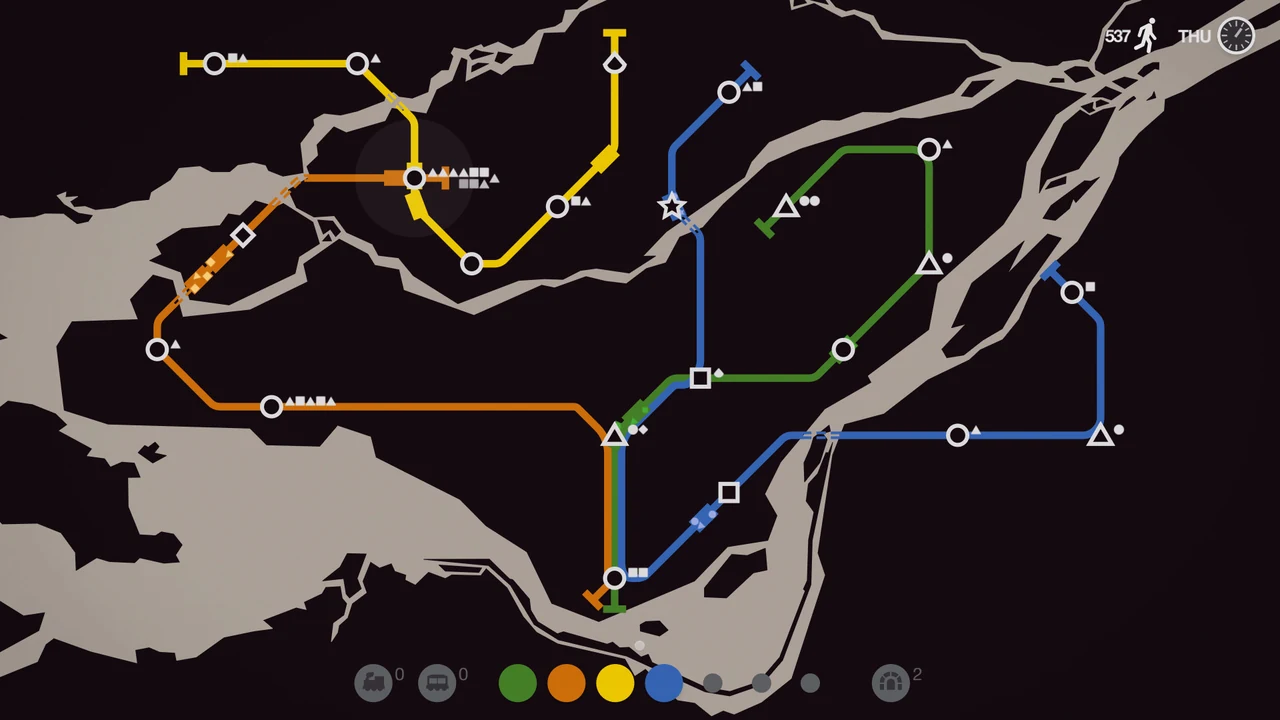
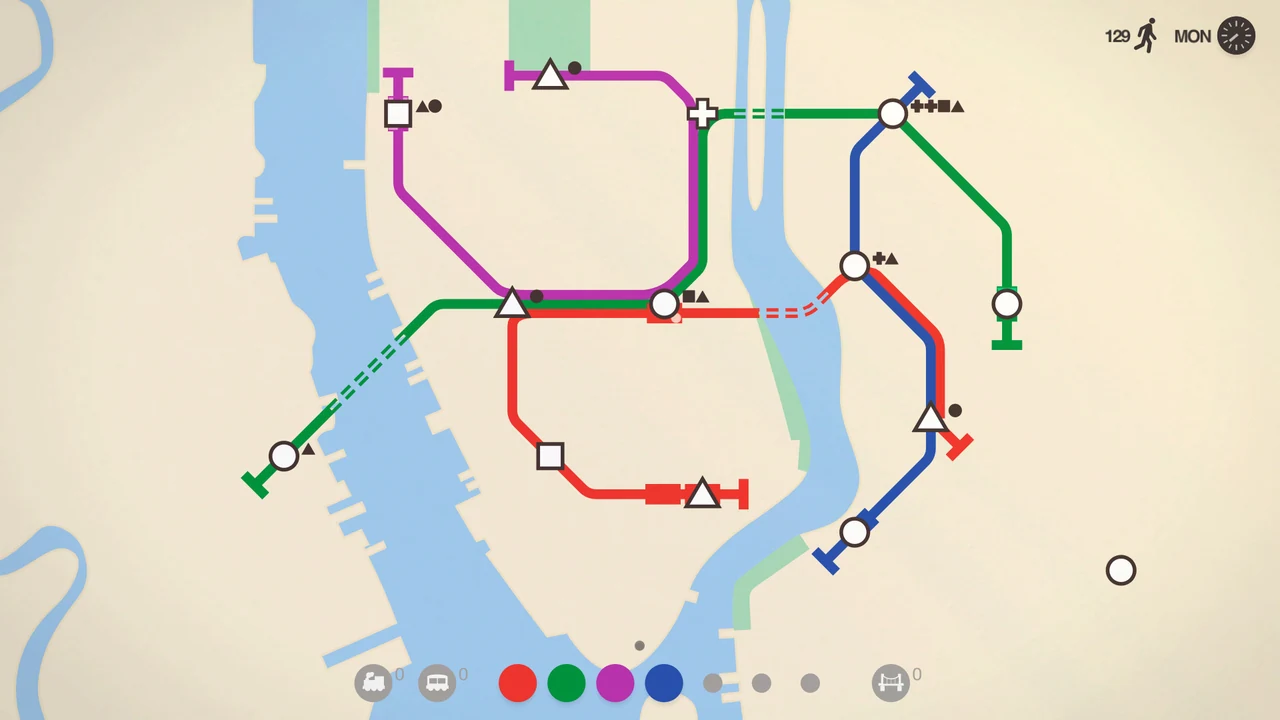
Mini Metro hands the player a transport commission in its simplest visible form. A few stations need a service, trains need routes, and passengers need access to different types of destination. Drawing the first lines is easy, but the network soon acquires obligations that a convenient initial layout cannot fulfil efficiently. New stops extend journeys, transfers concentrate demand and limited crossings can make a direct connection expensive. The opening gives a builder an unusually clean view of these relationships. There is no need to place decorative streets or manage individual buildings before the transport problem becomes interesting. The plan itself is the construction. Adding capacity and changing the route are separate decisions, and the player quickly has to decide which kind of improvement the current network actually needs before committing the next scarce resource.
Growth keeps the plan provisional
The game makes a network feel like something assembled rather than merely drawn. Stations, lines, carriages and crossings serve different functions, and their usefulness depends on the pattern formed by the whole system. A short route may deliver a reliable service, while an ambitious line can connect many destinations but create an awkward journey for passengers elsewhere. These trade-offs remain readable because the presentation strips the city down to the information needed for the task. Watching trains circulate gives the design a practical life of its own. City-specific geography changes the brief, encouraging a new plan instead of a universal layout copied into every map. For an infrastructure-minded builder, the strongest attraction is the connection between structure and operation: a network can look tidy and still need fundamental revision once its passengers reveal how they are actually using it.
The map is also the interface
There is a strict boundary around what can be built. Mini Metro concentrates on transit connections, with little decorative detail or wider urban economy to develop alongside them. That narrowness makes the network easy to understand, but it can leave city-building players wanting more ownership of the surrounding place. The growing demand also means a completed-looking arrangement is only temporarily adequate. Repeated revisions are part of normal play, including revisions to lines that once seemed ideal. Readers who enjoy finishing a project and quietly watching it operate may find that instability frustrating. The sparse visuals offer little diversion when congestion becomes the dominant concern. This is a focused operational challenge whose appeal rises or falls with the pleasure of making a transport system work. It should be selected for that responsibility rather than for a broad urban-development fantasy.
Return to test a different connection
Choose Mini Metro if a well-organised network is a satisfying construction in its own right. It suits players interested in capacity, connections and the practical consequences of route design, especially when they prefer a clear diagram to a visually busy simulation. The game can also be a useful change of pace for builders who usually manage many resources at once: the vocabulary is small, but the relationships remain demanding. Players seeking a permanent showcase city or extensive decorative tools should look elsewhere. The reward is operational elegance, achieved through changes that help passengers move more effectively. A willingness to replace an earlier plan is essential. For readers who enjoy that process, the game's restraint becomes its strongest feature, keeping the attention on whether the system being built truly serves the demand placed upon it.
The verdict
A sharply focused transit builder that makes the network itself the construction project. Its clean diagram supports meaningful operational decisions, with continual growth preventing a tidy plan from remaining finished.
Reasons to play
- A small toolset exposes the important transport relationships
- City geography gives each network a different construction brief
- Trains and passengers provide practical feedback on the design
Reasons to think twice
- There is little surrounding city or decorative detail to develop
- A network that works today may require rebuilding shortly afterwards
See the game
Assist & accessibility
Explore the available settings and control options on the official game page before choosing your setup.
Parents’ guide
Players: Single-player. No in-game purchase marker in the checked Steam listing. Separate downloadable content may be sold.
Age classification: 3. Nintendo Switch edition; not a separate PC classification
A useful starting tip
Investigate the cause of a crowded station before adding another long line; an awkward transfer can be more important than raw capacity.
A different direction
Compare this with Mini Motorways: An engaging infrastructure workshop where every road has an operational consequence. Rapid construction and visible traffic make redesign rewarding, while uncontrolled growth keeps the city from becoming a permanent blueprint.
Official sources
Reviewed: November 2026
You might also like
 DorfromantikRead review →
 Into the BreachRead review →
 Chicory: A Colorful TaleRead review →