PROJECT INSPECTION / SANDBOX TRAIL GUIDE
Into the Breach
A concentrated exercise in making a small toolkit protect a larger system. Squad coordination and limited actions deliver constructive satisfaction, with tactical consequences that demand difficult compromises.
DEVELOPED BYSubset Games

Game facts
- Developer
- Subset Games
- Publisher
- Subset Games
- Released
- 27 February 2018
- Platforms
- Windows · macOS · Linux (Steam edition)
- Model
- Paid game
- PEGI
- 12 · Bad Language — Steam UK listing
- Players
- Single-player
- Length
- Short
- Difficulty
- 4 / 5 · Challenging
- Steam Deck
- Verified
PEGI source ↗ · Steam Deck status source ↗
Edition: Base game
The score, explained
The interest and responsiveness of the core decisions and actions.
How progression, exploration and goals fit together.
The coherence of the visual, musical and narrative presentation.
How clearly the game explains its rules and offers useful ways to engage.
The depth of optional goals, alternative approaches and reasons to return.
Solve the attack that is already visible
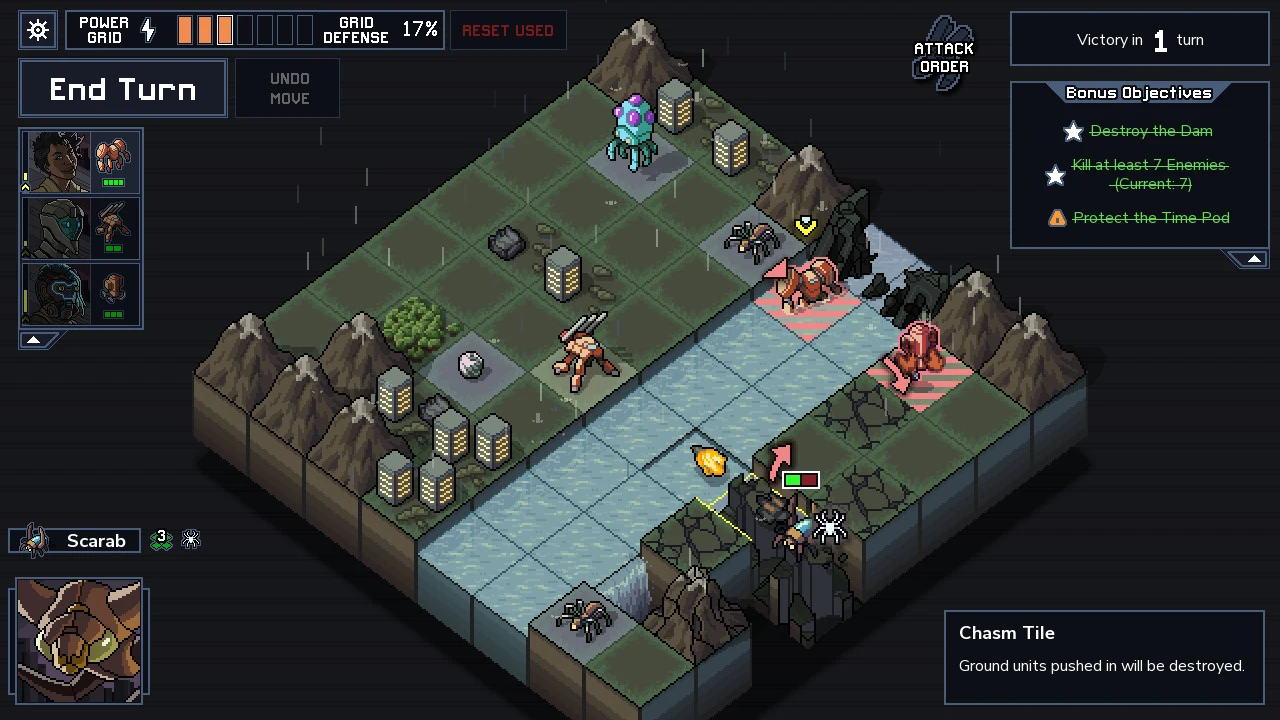
For a reader interested in designing systems, Into the Breach begins with a compelling constraint: a small team must keep a larger civilian structure functioning. The mechs have limited actions, buildings are vulnerable, and enemy intentions are visible before the response is chosen. That turns the first battles into exercises in allocating a scarce resource. Moving one unit can protect a building but remove another useful option, while an attack that shifts an enemy may be worth more than its damage. The opening asks players to study how the available machines work together. A squad is not merely three separate weapons; its capabilities form a toolkit for rearranging a dangerous situation. The construction happens at the level of a plan, assembled from positions, movement, equipment and the order in which actions are spent.
Small battles feed a larger attempt
The game excels at making a compact toolkit feel consequential. Different squads create different operating principles, and equipment choices can alter how a unit contributes to the whole. Because protecting infrastructure is central, success requires more than keeping the machines alive. The player has to design a response that distributes their limited actions across competing demands. Visible enemy attacks make this process concrete enough to analyse, while terrain and displacement introduce useful interactions among the pieces. An elegant turn can resemble an efficient small machine: one movement redirects a threat, another clears a route, and a final action completes several objectives. That coherence is especially appealing to a systems-minded builder. The battlefield may be temporary, but the satisfaction of arranging components so that each helps the others is recognisably the same kind of constructive pleasure.
A board built around consequences
This is still a tactical campaign, and its consequences are sharper than those of a forgiving construction toy. The available components do not always support a perfect plan. Sometimes protecting the power grid requires accepting damage elsewhere, and a promising expedition can deteriorate after a few poor decisions. Players drawn mainly to building a persistent place should also understand that the maps are compact battlefields rather than a settlement to inhabit and expand. The game offers little decorative ownership or long-form civic development. Its focus is on immediate functionality under pressure. That can be refreshing, but it also narrows the recommendation. Enjoying efficient systems will help; disliking adversarial constraints or the need to sacrifice one objective for another may outweigh that attraction. The toolkit exists to manage emergencies, not to provide unlimited creative freedom.
For players who enjoy reconsidering one move
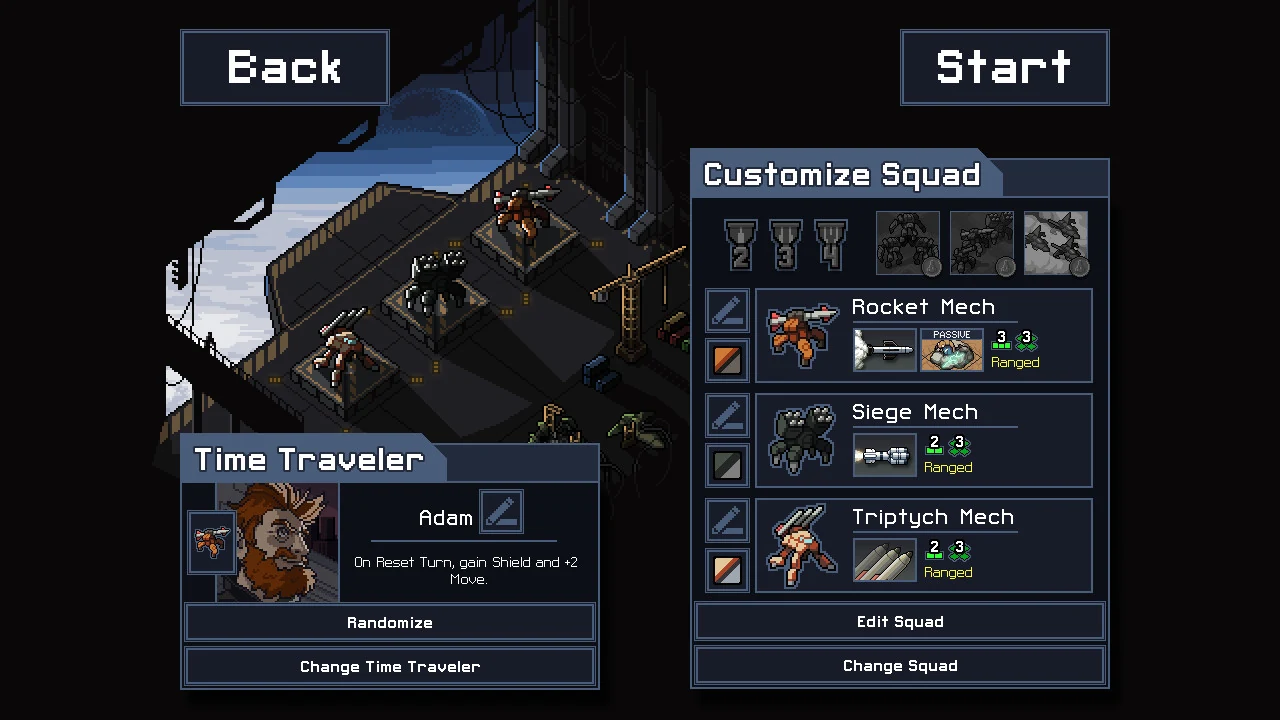
Into the Breach is a strong addition to a building-and-management catalogue when the appeal is coordination rather than construction scenery. Choose it if you enjoy arranging a few specialised tools into a plan that protects a larger system. The visible threats provide a clear brief, and the small maps make the results of a design easy to evaluate. It is particularly suitable for players who like optimising interactions without maintaining a large resource economy between every decision. Anyone wanting a tranquil sandbox or an enduring city should look elsewhere. This recommendation is for the practical planner who enjoys making a constrained arrangement work. A good squad turns several modest abilities into a useful whole, and the game repeatedly supplies situations that reveal whether the plan is robust enough to handle competing demands.
The verdict
A concentrated exercise in making a small toolkit protect a larger system. Squad coordination and limited actions deliver constructive satisfaction, with tactical consequences that demand difficult compromises.
Reasons to play
- Specialised mechs reward designing a coordinated plan
- Infrastructure protection makes priorities broader than survival
- Visible threats help evaluate the results of each arrangement
Reasons to think twice
- Some objectives cannot all be preserved
- Temporary battlefields provide little persistent or decorative ownership
See the game
Assist & accessibility
Explore the available settings and control options on the official game page before choosing your setup.
Parents’ guide
Players: Single-player. No in-game purchase marker in the checked Steam listing. Separate downloadable content may be sold.
Age classification: 12. Bad Language Steam UK listing
A useful starting tip
Look for a move that prevents several attacks through displacement before assuming every threat must be destroyed this turn.
A different direction
Compare this with Mini Metro: A sharply focused transit builder that makes the network itself the construction project. Its clean diagram supports meaningful operational decisions, with continual growth preventing a tidy plan from remaining finished.
Official sources
Reviewed: November 2026
You might also like
 DorfromantikRead review →
 Chicory: A Colorful TaleRead review →
 FrostpunkRead review →