PROJECT INSPECTION / SANDBOX TRAIL GUIDE
Frostpunk
A powerful survival city builder where infrastructure and social policy are inseparable. Its coherent pressures make construction consequential, but the bleak tone leaves little room for carefree development.
DEVELOPED BY11 bit studios

Game facts
- Developer
- 11 bit studios
- Publisher
- 11 bit studios
- Released
- 24 April 2018
- Platforms
- Windows (Steam edition)
- Model
- Paid game
- PEGI
- 16 · Strong Language — Steam UK listing
- Players
- Single-player
- Length
- Medium
- Difficulty
- 4 / 5 · Challenging
- Steam Deck
- Playable
PEGI source ↗ · Steam Deck status source ↗
Edition: Base game
The score, explained
The interest and responsiveness of the core decisions and actions.
How progression, exploration and goals fit together.
The coherence of the visual, musical and narrative presentation.
How clearly the game explains its rules and offers useful ways to engage.
The depth of optional goals, alternative approaches and reasons to return.
A city organised around survival
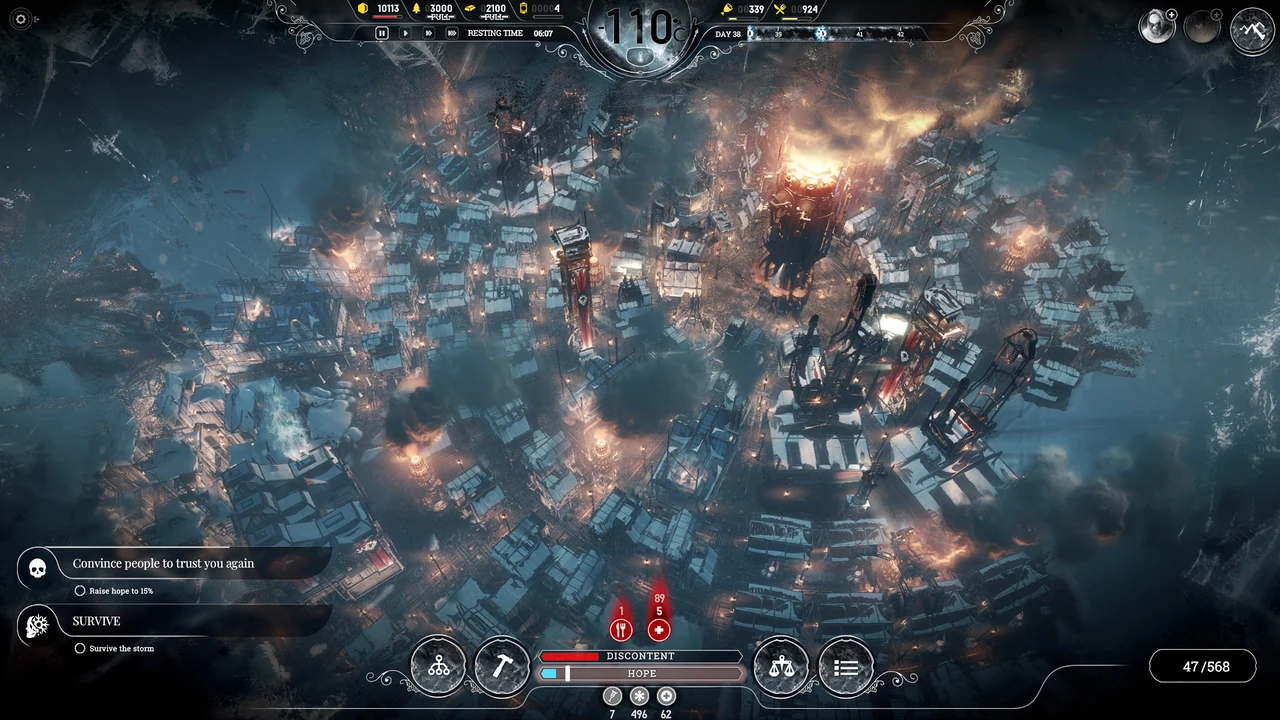
Frostpunk makes the purpose of a settlement immediately clear: people need a functioning refuge from lethal cold. Heat, food, shelter and the resources required to support them arrive as competing priorities, with the generator giving the city a visible centre of dependence. Early construction is therefore about survival relationships rather than selecting the most attractive arrangement of buildings. A workplace needs labour, heating consumes resources, and a new group of residents changes the demands placed on the existing plan. The opening also introduces laws as tools for responding to pressure. These decisions have a social meaning as well as an economic effect, so the settlement begins acquiring a character through its compromises. The builder's first challenge is to establish a viable routine while recognising which emergency fixes may become commitments the city must continue living with.
Laws make the plan a social choice
The city works as a convincing management problem because its systems converge on the people living within it. A shortage is not merely a lower number on a dashboard; it changes the urgency of work, warmth and public confidence. The generator's central role makes spatial planning legible, while changing conditions prevent an initially effective arrangement from remaining sufficient forever. Laws connect those practical demands to the kind of society being created. This gives construction decisions an unusually strong thematic consequence: expanding capacity can also mean accepting a harsher routine or a difficult social bargain. Scenarios and Endless Mode offer different structures for engaging with the underlying systems. The essential appeal remains consistent across them. A settlement has to function as a whole, and the game repeatedly tests whether its economic plan, physical layout and social choices can support one another under worsening conditions.
The cold has a practical role
Frostpunk gives relatively little space to building for appearance alone. The cold establishes urgent priorities, and a beautiful arrangement offers limited comfort if its people lack essential services. That pressure can make the experience feel more like crisis administration than a leisurely construction project. The moral framing also means that efficiency is not always emotionally satisfying; a functional decision may produce a society the player dislikes. Readers wanting clear, uncomplicated rewards for good planning should expect a more uncomfortable relationship with success. Its bleak subject matter and repeated emergencies can become exhausting, particularly when a recovery plan is overtaken by another demand. The modes offer different structures, but the game's identity remains tied to survival pressure. Choosing it for a relaxed creative mood is likely to produce a mismatch, however appealing the circular city may initially look.
Choose it for consequential pressure
Frostpunk belongs in the collection of a builder who wants construction decisions to carry human consequences. It suits players willing to balance immediate survival against the long-term shape of a society, and to keep revising a plan when conditions deteriorate. The strongest attraction is the connection between a visible city and the policies that keep it operating. Players looking for unrestricted decoration, cheerful expansion or a consistently forgiving management loop should approach more cautiously. The game is demanding in tone as well as in its resource relationships. For the right audience, that seriousness gives every new workplace, shelter and law a weight that many builders lack. Choose it when you want to answer a difficult civic brief: make the settlement survive, while deciding what surviving should require from the people who depend on it.
The verdict
A powerful survival city builder where infrastructure and social policy are inseparable. Its coherent pressures make construction consequential, but the bleak tone leaves little room for carefree development.
Reasons to play
- Heat gives the city a clear spatial and economic centre
- Laws connect resource problems with social consequences
- Survival systems continually test the settlement as a whole
Reasons to think twice
- Emergency priorities sharply limit decorative freedom
- A successful economy can still feel morally uncomfortable
See the game

Assist & accessibility
Explore the available settings and control options on the official game page before choosing your setup.
Parents’ guide
Players: Single-player. No in-game purchase marker in the checked Steam listing. Separate downloadable content may be sold.
Age classification: 16. Strong Language Steam UK listing
A useful starting tip
Before passing a law, consider the social commitment it creates as carefully as the resource problem it appears to solve.
A different direction
Compare this with Against the Storm: A rich settlement manager that keeps the difficult establishment phase at the centre. Varied populations and production options reward adaptable plans, provided repeated rebuilding is part of the appeal.
Official sources
Reviewed: November 2026
You might also like
 DorfromantikRead review →
 Into the BreachRead review →
 Chicory: A Colorful TaleRead review →